Renacit
Bicarbonate Hemodialysis Citrate Concentrate
Description
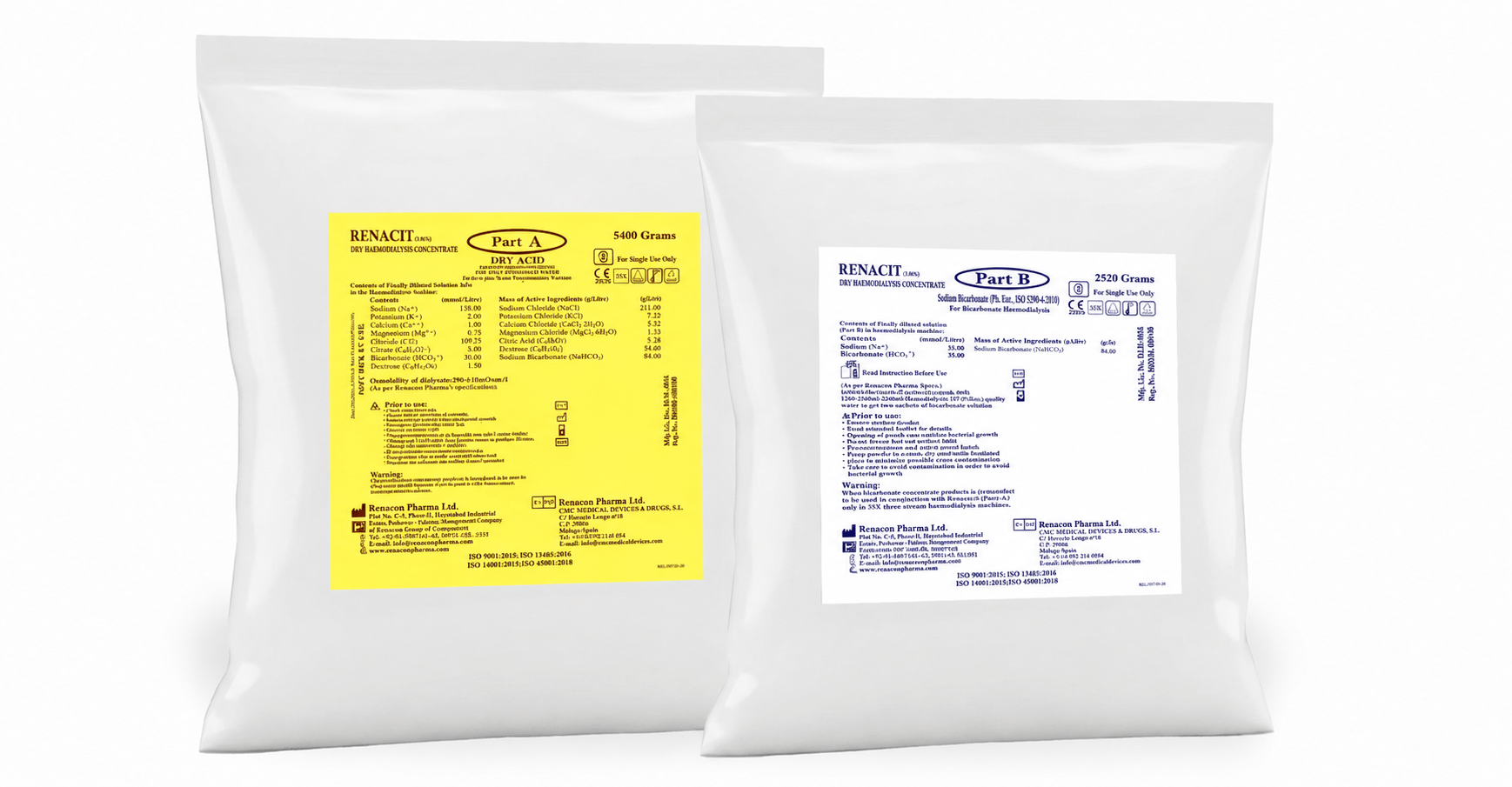
Renacit
- Part-A: Powder form
- Part-B: Powder form
Renacit-S
- Part-A: Solution form
- Part-B: Powder form
Renacit is a bicarbonate hemodialysis concentrate formulated with sodium citrate as the buffering agent, replacing a significant portion of the acetate conventionally used in dialysis concentrates. Citrate dialysate enhances anticoagulation within the extracorporeal circuit, allowing up to a 55% reduction in heparin dosage.
Advantages to Patients & Society
- Reduces heparin requirement in dialysis patients by up to 40%
- Improves dialysis adequacy with Kt/V >1.2 and URR >70%
- Significantly reduces clotting during heparin-free hemodialysis
- Enhances Kt/V in dialyzer reuse by improving fiber clearance
- Increases dialyzer reuse potential by 60–100%
- Does not cause thrombocytopenia
- Eliminates the risk of heparin antibody formation
- Reduces heparin-related treatment costs
- Significantly lowers bleeding episodes when heparin is reduced or eliminated
- Eliminates heparin-related complications such as osteoporosis, pruritus, and disturbed lipid metabolism
- Minimizes clotting in patients with frequent dialyzer clotting
- Eliminates acetate-related complications associated with conventional dialysis concentrates
- Provides antioxidant effects
- Improves acid-base balance
- Reduces inflammation
- Lowers pre-dialytic β2-microglobulin levels
- Improves patient tolerance to hemodialysis treatment
- Avoids heparin-induced myeloperoxidase release associated with the progression of atherosclerosis
- Suitable for patients with liver failure undergoing hemodialysis
Indications
- Routine hemodialysis
- Heparin-free hemodialysis in patients with active bleeding
- Patients with suspected bleeding or a high risk of bleeding
- Patients with impaired coagulation or clotting disorders
- Patients with absolute or relative contraindications to heparin
- Frequent dialyzer clotting
- Heparin allergy or heparin intolerance
- Thrombocytopenia (low platelet count)
- Patients requiring improved dialysis adequacy (Kt/V) and enhanced dialyzer reuse
- Preoperative and postoperative hemodialysis
- Patients with gastrointestinal bleeding or active peptic ulcers
- Patients with hemorrhagic retinopathies
- Patients with acetate-related complications, including recurrent hypotension, arrhythmias, and nausea
- Elderly, malnourished, or long-term hemodialysis patients at increased risk of acetate toxicity
- Patients experiencing heparin-related adverse effects, including pruritus, osteoporosis, and accelerated atherosclerosis
- Hemodialysis in patients with liver failure and impaired coagulation
Clinical trails on the use of citrate containg dialysates
- Each pack is designed for five 4-hour hemodialysis sessions and includes Part A (powder), Part B (powder), and Part C (Acetum) liquid
- For the Americas: Part A is supplied as powder for 5 gallons, Part B as powder for 10 gallons, and Part C (Acetum) is provided in a bottle to be mixed with Part A
- One carton contains 5 packs of Part A and 5 packs of Part C (Acetum), providing a total of 25 dialysis sessions
- Part B is packed separately, with 5 packs per carton, also sufficient for 25 dialysis sessions
- Parts A and B are packed in high-quality, durable LDPE packaging that is strong, leak-proof, user-friendly, and resistant to damage
- Supplied in sturdy, elegantly printed cartons for safe storage and transportation
- Labels can be printed in the importer’s preferred language in compliance with ISO and CE standards
Heparin Adverse Effects
- Increased bleeding tendency
- Heparin-induced antibody formation
- Heparin-induced thrombocytopenia (HIT)
- Dialyzer clotting
- Osteoporosis associated with long-term heparin use
- Heparin-related pruritus
U.S. FDA Safety Alert (2006):
The U.S. Food and Drug Administration (FDA) issued a safety alert highlighting the risk of heparin-induced thrombocytopenia (HIT), a serious immune-mediated adverse reaction that can lead to heparin-induced thrombocytopenia with thrombosis (HITT). The FDA noted that HIT may occur during treatment or several weeks after discontinuation of heparin therapy, emphasizing the importance of prompt evaluation in patients presenting with thrombocytopenia or thrombotic events.
Disadvantages of Acetate in Bicarbonate Concentrates
- Conventional bicarbonate dialysis concentrates typically contain 2–10 mmol/L of acetate
- Acetate metabolism increases oxygen consumption, which may contribute to hypoxemia
- Acetate metabolism can produce aldehydes associated with headache and nausea
- May contribute to vasodilation, hypotension, and cardiac arrhythmias
- Associated with accelerated atherosclerosis and micro-inflammation
- Elderly, malnourished, and long-term hemodialysis patients are more susceptible to acetate toxicity
RENACIT contains only 0.3 mmol/L of acetate, significantly reducing acetate exposure while maintaining effective bicarbonate hemodialysis.
Guidelines for Use
- Renacit contains a low concentration of citrate, providing localized anticoagulation within the extracorporeal circuit without increasing systemic bleeding risk
- To be prescribed and used only under the supervision of a qualified physician
- Verify the label, formulation, and proportioning ratio (35×, 36.8×, or 45×) before use
- Use the cartridge or Part B concentrate as per standard dialysis practice
- Dialysate flow may be increased to 600 mL/min to optimize anticoagulatory effect when clinically indicated
- Ensure the extracorporeal circuit is free of air or microbubbles to minimize clotting
- Reduce the heparin dose gradually while monitoring ACT or aPTT to achieve the desired level of anticoagulation
- In patients with heparin-induced thrombocytopenia (HIT) or heparin allergy, discontinue heparin and use saline flushing with RENACIT as directed by the treating physician
- Monitor venous pressure and the dialysis circuit closely when heparin is reduced or discontinued
- In patients with recurrent dialyzer clotting, RENACIT may also be used with the standard heparin dose
- Unused Part A solution may be used for the next dialysis session, provided appropriate storage conditions are maintained
- Electrolytes such as calcium and potassium may be added to Part A according to the physician’s prescription
Precautions
Rare cases of hypocalcemia may occur due to the temporary binding of calcium by citrate during dialysis, resulting in a transient reduction in ionized calcium levels. Patients should be monitored for symptoms such as perioral numbness or tingling, hand muscle spasms (tetany), or persistent muscle cramps. If these symptoms occur, place the dialysis machine in bypass and administer intravenous calcium gluconate slowly as clinically indicated. Symptoms are generally transient and resolve rapidly as citrate is quickly metabolized by the body.
Frequently Asked Questions
Q: Is frequent or continuous intra-venous Calcium is necessary during Hemodialysis with RENACIT?
Answer: No. Calcium binding by dialysate Citrate is very small and only 10% of the Ionized Calcium may decrease in the blood. There is also the usual amount of calcium in the dialysate.
Q: How does Citrate dialysate function?
Answer: Citrate, being an anti-coagulant, is present in very little amount in the Dialysate. Hence anti-coagulation effect is only in the extra-corporeal circuit and it is rapidly neutralized upon entry in the systemic circulation.
Q: Is it necessary to check clotting times when RENACIT is used?
Answer: No.
Q: Is there reason to be concerned about bleeding risk?
Answer: No. Citrate is a local anticoagulant, it means that it does not have systemic anticoagulation effects. Once blood is returned to the patient the citrate is uncomplexed from calcium and is readily metabolized.
Q: Is there reason to be concerned about hypocalcemia, or hypomagnesemia when treating patients with citrate dialysate?
Answer: The concentration of Citrate in the dialysate is low, so is the risk of hypocalcemia or hypomagnesemia with normal concentrations of dialysate calcium and magnesium.
Q: When using RENACIT what changes I should make in the present Dialysis System?
Answer: No changes are required.The existing Dialysis system is fully compatible to use RENACIT.
Q: What are the advantages regarding Dialyzer Reuse
Answer: Dialyzers’ fibers are properly cleared with use of RENACIT hence number of dialyzer reuse increases while clearances (Kt/V) increase or remains fairly good.
Q: Is RENACIT much more expensive than other Bicarbonate Concentrates
Answer: No. Inspite of significant advantages there is no significant difference in price.